
What You Tolerate, You Author
On complicity, and the dial you forgot was yours

For eleven years I kept a friend who never once asked me a question. Not a real one. He would ask whether I had read the thing he sent, whether I agreed with him, whether I was free on Saturday, and once, memorably, whether I thought he should grow a beard. I told myself this was a quirk. Some people are built facing outward. Houseplants manage it without embarrassment, tilting at the window all day, and nobody thinks to scold them. I used to be the obliging one, the one who rescued stalling dinners and remembered the anniversaries of other people’s griefs. The arrangement balanced out somewhere I couldn’t see, I decided. But it did not balance out. What had happened, very slowly, in instalments, at dinners, was that I had agreed to become a person who did not need to be asked.
Nobody votes on who they become. There is no ballot. You consent in tiny amounts, almost below the threshold of noticing, in the half-second where you could say “actually, no” and instead you pass the bread and reach for the lighter tone, and the moment closes before you have noticed it was a chance to do otherwise.
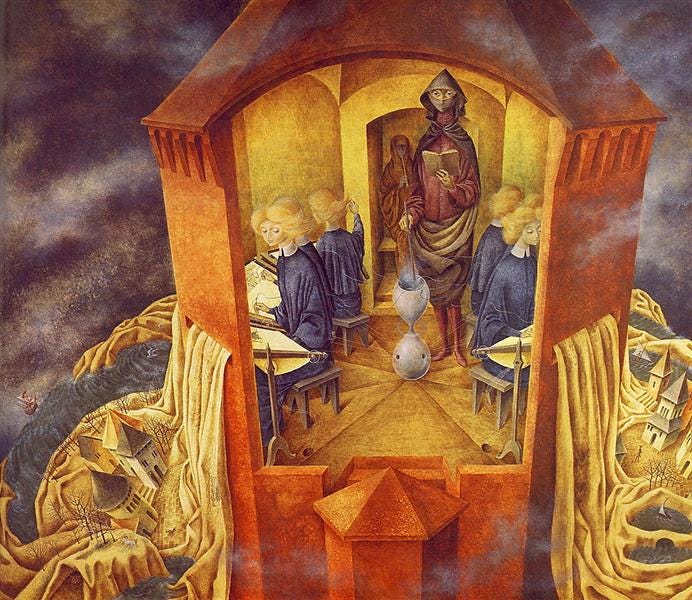
There is an old and faintly bullying idea that we are the authors of our own lives. It tends to arrive on a poster. Or worse, painted on the wall of a wellness studio in a typeface engineered to look handwritten, as if sincerity were a font. I have always found the slogan insufferable, mostly because the people repeating it usually mean you alone are to blame for everything that has gone wrong for you, which is cruel, and also, if you have ever met an actual human life, untrue. So much of what lands on a person was never put to a vote of theirs. Illness lands on you. So does the century, the country, the language, the question of whether the people who raised you had any real notion how. None of it turns up with a return address.
But you write something. And here is the part that took me an embarrassingly long time to understand, longer than those eleven years, if I am honest. You write it most decisively in the places you have trained yourself to call out of your hands.
You write it in what you let stand.
Not your dramatic refusals. Not the time you finally slammed the door, told the boss, ended the thing in the restaurant while the waiter hovered with the dessert menu and pretended to study the middle distance. Those are the scenes we rehearse afterwards, the ones we polish into anecdotes. They flatter us. So no! The authoring happens earlier and lower down, in the accommodations so small and so frequent that they never once register as decisions at all. The comment you let pass. The arrangement you call “just how it is”. The slightly humiliating thing you reframe, in real time, as fine, as character-building, as not worth the fuss, as the price of keeping the peace at a table you are not even sure you want to sit at.
Each of those is a sentence. You are writing yourself, in the passive voice, and calling it….. fate.
Consider the radiator. When I was very young, for two winters I lived in a flat where the radiator in the main room produced heat on roughly the schedule of a government apology, announced in principle and never arriving in the room where you actually stood. I wore a coat indoors. I told guests it was charming, très bohème, the writer in her garret, and the frightening part is that I believed myself. I did not write to the landlord. To write to the landlord would have meant conceding that I lived somewhere cold, that I had been living somewhere cold for two winters running, that the coat was not an aesthetic but a verdict. So, I authored a woman who finds the cold romantic instead. I wrote her rather well. She had views on candlelight and a way of saying that central heating dries out the skin.
This is the genre of decision I mean. Not heroic. Faintly ridiculous, mostly, once you catch it in decent light.
The accommodations that cost us the most are almost never the ones that arrive looking like sacrifice. They arrive looking like preference, like taste, like personality.
We mistake the shape our endurance has pressed into us for the shape we were born in, and then we defend it, with real heat, the only heat in the flat, against anyone tactless enough to suggest that we might turn up the dial, or leave, or write the letter, or simply stop pouring.
And I’d like to be careful here because there is a version of this thought that becomes monstrous very quickly, and the internet is full of it. The version that tells the woman she chose her circumstances. That tells the poor they manifested it. I am not interested in that essay, and I would ask you to leave the room if that is the one you came for. Complicity is not the same as cause. Some things are simply done to us, and naming our small share in what we tolerate is not the same as handing the powerful a receipt.
And yet.
What I cannot put down is how much of a life turns out to be made of permissions we never remember granting. I think about it more than is good for me. I think about it in the middle of the night, which is when the accounting department of the soul keeps its hours.
So let me ask you the question I spent most of my adult life avoiding, and then, on the far side of it, tell you the unglamorous truth about how a person actually begins to author the life they keep blaming on everyone else. I did begin. Not heroically, and not all at once. But I begin to think the how is the only part worth writing down.