
Truth Needs No Translation
Satyagraha, collective endurance, soul-force and the discipline of not resolving

“The pursuit of truth does not permit violence on one’s opponent.” — Ghandi
Language will not hold a particular kind of suffering. Not the suffering of a wound or a grief, which language at least tries to cradle, but the suffering of a system, of a structure, of the slow violence that has no single author and therefore no single sentence that can name it.
This is the suffering that Tolstoy wrote about, that Thoreau half-understood, that the 20th century perfected at an industrial scale without ever quite explaining. And it is precisely this suffering, this grammar-resistant fact of collective injustice, that Philip Glass chose to build an opera around in 1980. Not to resolve it. Not to narrate it. But to sit inside it, for three hours, and refuse to leave.
Satyagraha is an opera about Gandhi’s years in South Africa, from 1893 to 1914. That much is factual. But to describe it that way is like describing a fever by its temperature. The work is sung entirely in Sanskrit, a language the audience does not understand, which means the audience spends the evening receiving something other than information. The libretto is drawn from the Bhagavad Gita. There is no conventional plot in any sequence that a Western operatic tradition would recognise; scenes do not cause other scenes, characters do not arc. Instead, Glass constructs a kind of temporal pressure, where repetition is insistence, never laziness. The music circles. It insists. It finds, in its refusal to move forward, a form of political statement that most political art, in its urgency to arrive, never makes.
Which raises the question of what political art is actually for.
Most of it, I would argue, is for the already-converted. It flatters its audience by confirming what they already believe, dressing conviction in the rhetoric of revelation. The protest song that makes you feel revolutionary while standing in your kitchen. The documentary that explains a crisis in ninety minutes so you can feel informed without being implicated. We have developed, as a culture, an extraordinary apparatus for processing injustice aesthetically, which is one reason so little changes. The machine is efficient. The catharsis is prompt.
Glass does something different and considerably less comfortable. He removes catharsis as an option. In Satyagraha, because nothing resolves, because the harmonic language keeps returning to itself, the emotional state the audience is left in is something closer to waiting than to feeling. And waiting, it turns out, is the central political fact of the opera’s subject. Satyagraha is the Sanskrit term Gandhi used to describe his method of nonviolent résistance, typically translated as “truth-force” or “soul-force”, though neither translation quite survives the crossing. The concept is not passive. It requires an active holding of something, a refusal to relinquish pressure while refusing violence, a discipline so counterintuitive that even those who admired it theoretically rarely managed to practise it in the long dark middle hours when nothing was happening.
The opera is interested in those hours. Not the speeches. Not the martyrdom. The hours when you sit with the unbearable and do not hit back.
I wonder sometimes whether the Western philosophical tradition was ever quite equipped to understand this. We have traditions of endurance, naturally: the Stoic literature, the Christian martyr cults, the existentialist wrestling with absurdity. But even Camus, that most Mediterranean of philosophers, frames the absurd as something the individual confronts and privately overcomes or doesn’t.
The Camusian hero is, at bottom, alone. Gandhi’s satyagraha requires company. It requires community. It requires the extremely difficult agreement to remain nonviolent when provoked, repeatedly, in coordination, over years, which is not a private spiritual achievement but a collective one, and therefore one that all our existing frameworks of heroic selfhood are quite bad at describing.
Perhaps that is why Glass set the opera in Sanskrit. There is something in the choice that says: ordinary language is not adequate to this. Let the audience sit without comprehension and receive through the body instead.
The body receives it. I can confirm this.
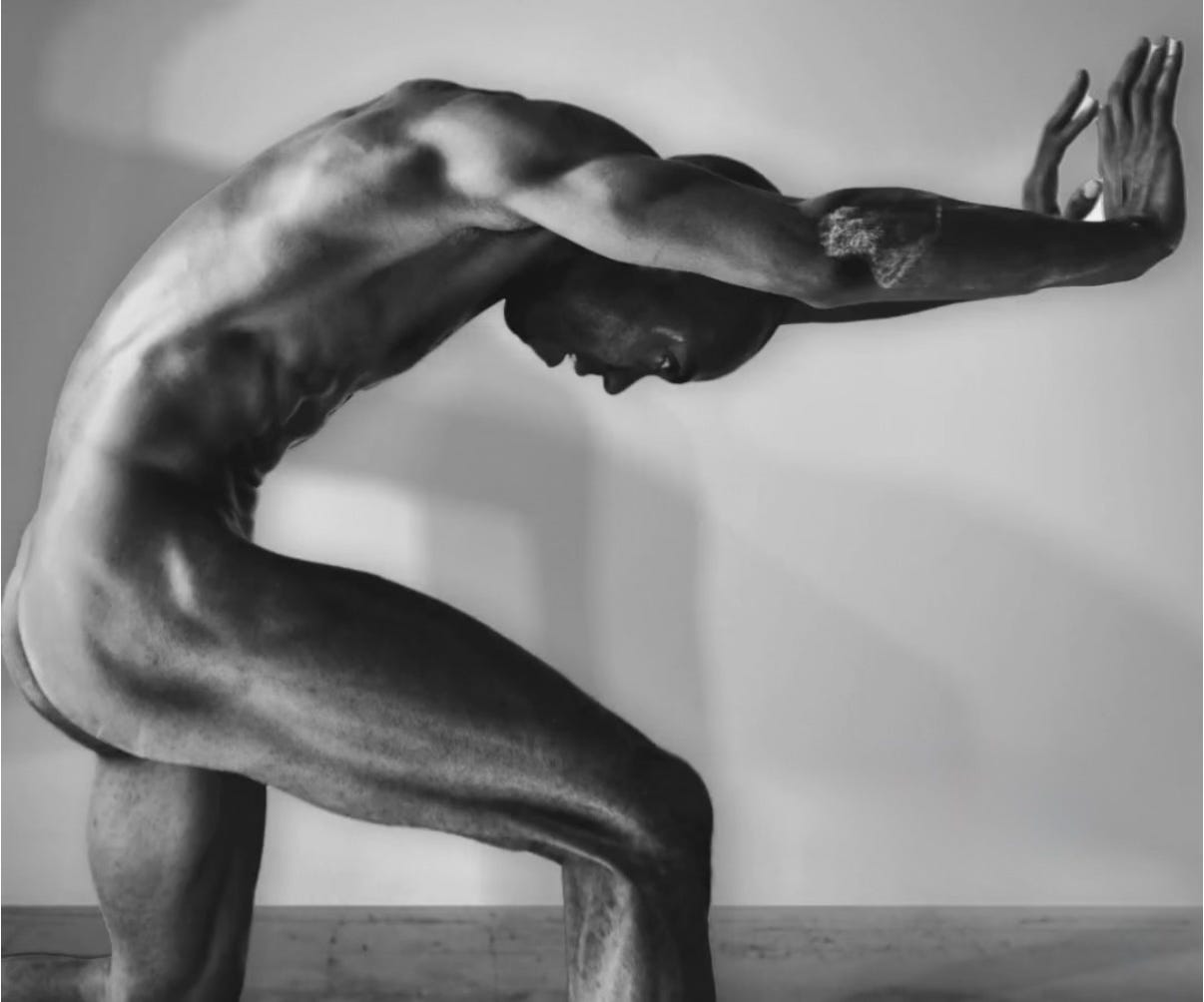
There are dancers in Satyagraha, which is not incidental. They move through the opera’s scenes with a slowness that refuses spectacle, bodies that do not punctuate the music so much as inhabit it, as though the choreography were less a performance of meaning than a demonstration of what it costs to remain present inside something that will not resolve. Ballet trained me, for years, in the discipline of the body as argument, the idea that a held position carries more rhetorical force than a gesture, that stillness is not the absence of movement but its most demanding form. Watching the dancers in Glass’s opera, I recognised something I had not thought about in a long time. The body knows things about endurance that the mind routinely refuses to learn, that what satyagraha asks – stay, hold, do not retaliate – is not first a philosophical position but a physical one, made in the muscles and the breath before it becomes a political act. The dancers do not illustrate the opera. They are its argument, made flesh, made slow, made irrefutable.
And now here we are! The current political moment is something Satyagraha seems almost to have anticipated, though Glass was not a prophet, merely unusually honest about what the present always contains. Look at 2025: mass protests across Serbia, South Korea, Georgia, France, Iran, the United States and thirty other countries if you count carefully; young people who had never stood in a public square suddenly standing in one, because the alternative felt morally worse than the cold.
The résistance is real. It is also not enough, and nobody quite knows what to do with that sentence, so most people return to their phones and their fury, which have by now become practically the same thing.
The low-grade political panic has become a background frequency that the body simply absorbs, until you can no longer distinguish between being informed and being exhausted. What satyagraha demands, and what Glass’s opera enacts, is the refusal of both terms: neither the numbing nor the reactive noise, but the third option that our current media environment has made almost unimaginable. The sustained, unremarkable, unperformable holding of a position over time.
We are not, most of us, capable of it. I include myself without irony.
The Bhagavad Gita, from which the libretto is drawn, is itself concerned with exactly this problem: what to do when action seems both necessary and impossible, when the ethical demands of the moment are so enormous that the temptation is to put down your weapons on the battlefield and simply not engage. Arjuna, paralysed before the battle at Kurukshetra, is told by Krishna not that the outcome justifies the action, but that action aligned with duty is required regardless of outcome. This is not a comfortable idea. It is deeply unsettling, particularly for those of us who have invested significantly in the belief that good actions produce legible results in reasonable timeframes. They often do not. Gandhi knew this. Tolstoy, who corresponded with Gandhi in the last months of his life, knew this. They found in each other, across two continents and entirely different traditions, an agreement that the moral demand of nonviolence was unconditional, not strategic.
Not: resist because it will work. But: resist because to not resist is to have already lost something more fundamental than the immediate fight.
The opera puts Tolstoy on stage. Also Martin Luther King, also the poet Rabindranath Tagore. They appear as presences, not explained and not dramatised. Glass is not interested in the mythology of the great man. He is interested in the force that moves through and around great men, the force that is historical and also something older, something that keeps reasserting itself whenever enough people decide that the terms of the given situation are wrong.
Most political art cannot locate that force because it is too busy narrating the biography of whoever holds it momentarily. We love a face on a poster. We love the speech that turned the tide, the moment of singular courage, the scene that screenwriters call “the ordeal”. What we struggle to represent, and therefore to value, are the years of unglamorous collective endurance before the speech, the thousands of unnamed people who held the position without knowing whether it would be held long enough to matter. Satyagraha is an opera about those people, even when Gandhi is standing at the centre of the stage.
Simone Weil wrote that affliction becomes real at the moment the sufferer recognises the world’s indifference to their suffering. What remains possible after that recognition is the question. What remains moral. Glass’s answer, which is not an argument but a sonic fact, is that what remains possible is presence. The refusal to be moved, in both senses, from your position, and into someone else’s emotional economy of panic and reaction. Weil herself practised this to a degree that destroyed her health and possibly her life, which is either a cautionary tale or a testament, depending on where you stand and how cold you find the room.
A few days ago, I saw Satyagraha for the first time, an invitation extended by the soprano Olivia Boen, who sings in the production with a discipline the role demands, a voice that carries not feeling in the operatic sense but something closer to conviction, which is an entirely different instrument. She was generous enough to include me, and I went without quite knowing what the evening would do. The 10th of April marks the opera’s premiere at the Palais Garnier, the first staging in that house’s history, which is the kind of cultural fact that makes you briefly wonder what Paris was doing between 1980 and now. Probably what it always does… being beautiful and a little complacent and then suddenly, when you least expect it, paying attention.


What the evening did to me is not easy to paraphrase. I left the theatre not cleansed, not uplifted, but altered in some more obscure way, like a piece of paper that has been lightly dampened and left to dry. Something in my shape was different. The sonic repetition had done something to my sense of time, and the low-grade urgency I carry constantly had been displaced, not soothed but replaced, temporarily, by something more durable… the sensation that it is possible to hold a position for a very long time without resolving it, and that this is not a failure to act but is itself a form of action.
Glass found a musical form for this, and this form is now being heard for the first time inside the chandelier-heavy, resolutely Haussmannian interior of the Opéra Garnier, and that is not without friction. The institution of European privilege hosting the aesthetics of collective endurance. Five centuries of gilded self-confidence receiving a work about Indian indentured labourers in colonial Natal, singing a Sanskrit scripture that no one in the audience can parse. I would not smooth that friction if I could. It belongs there.


What frightens me, sitting here with the opera still humming somewhere under my sternum, is not the state of the world, which has always been approximately this bad and occasionally worse, but the state of our attention, which has not. We are living through the first period in human history in which the infrastructure of collective life has been deliberately engineered to make sustained thought, sustained grief, and sustained résistance all equally difficult, equally unrewarding, equally easy to exit.Satyagraha is an affront to that infrastructure. It cannot be summarised. It cannot be clipped. It will not perform its meaning in the first thirty seconds. And sitting inside it, held by its refusal to hurry, I thought: this is what a civilisation that still believes in itself sounds like. I am not sure we sound like this anymore.
Walking out into the April night on the Place de l’Opéra, I found I could not summarise what had passed through the room. It was not information, not catharsis, not entertainment in any sense the algorithm could process or reward. A transmission of a different order. You do not leave Satyagraha knowing what to do. You leave it knowing, in some way that bypasses argument entirely, that the question of what to do is not going away, and that the people who have lived inside that question most honestly have never been the ones who answered it quickly.


From a city that has always confused beauty with immunity, on the night after an opera that reminded me, without argument and without mercy, that the most political act available to us may simply be the refusal to let go of what we know to be true,
Tamara
Not a tip jar. A ledger for what you underlined in your mind.


You point to something here that few understand or are willing to engage with: that most political discourse has little to do with the issues at hand, with solutions or any moral imperative of governance. To put it more accurately, to the extent that it involves or is motivated by these things, they are not the primary motivation. Resolution is not about truth or justice; it's about catharsis. It's the desire we have to offload the dissonance we feel when confronted with some intractable political problem. The homeless person needs to disappear, not find a home; the bombed school is more tolerable when it's halfway across the world, happening to people who don't look like you; the victim needs blaming because it's much more cathartic to believe that the world is just, and that bad things only happen to those who fail along some moral dimension.
To simply endure; to hold the dissonance without relenting one way or the other; to insist on nuance and to avoid picking sides, when neither side is telling the truth or deserves your loyalty; these things are an absolute anathema to the modern western world, post smartphone and social media symbiosis. For all the reasons you mention, to hold an unresolved position; to fail to take sides; to deny yourself the catharsis of resolution, is the LEAST marketable thing I can imagine, because it's the hardest sell there is. Imagine selling a product or service without the promise of identity, validation, piece of mind, fairness, justice, happiness, personal transformation, acceptance, and the empty mantra that "you're enough".
That performance didn't change you, because your writing, in its own way, has reflected the very same ethic. This is the reason why I always applaud you for not tying your pieces up in neat little bows of resolution. The truly subversive, avant garde thing to do in this day and age is precisely what you have been doing: producing writing that believes itself, in recognition that the work will never be done.
Brilliant work, Tamara.
Your essay identifies something that political analysis often misses. Endurance is a temporal structure. What Satyagraha accomplishes formally is the reconfiguration of time itself. Repetition, in Glass’s score, suspends the narrative demand that something must happen. And that is precisely where the political force enters. Systems of injustice depend on a choreography of acceleration, like crisis, reaction, outrage, replacement, each event rapidly displacing the last. By refusing narrative velocity, the opera withdraws from that choreography. It does not compete with the tempo of power, it alters the tempo of perception.
There is a striking parallel here with certain developments in modern visual art. Consider how Minimalist painters or sculptors replaced the drama of representation with duration and attention. A painting by Agnes Martin or a sculpture by Donald Judd does not announce meaning. Only holds a condition. At first encounter the viewer thinks nothing is happening, but slowly the perceptual field reorganizes itself around patience. The artwork becomes less an object than a training apparatus for attention. What Glass seems to understand, perhaps more intuitively than many political theorists in my opinion, is that this training of attention is itself a political capacity. Collective endurance cannot exist without a shared ability to remain inside unresolved time.
Your observation about the dancers is therefore crucial. In art history one often distinguishes between gesture and structure. Gesture is expressive, immediate, legible. Structure is what sustains pressure over time. Much contemporary political expression favors gesture: the speech, the slogan, the viral image. But satyagraha belongs to the category of structure. It resembles less the rhetoric of protest and more the architecture of a cathedral, an arrangement of forces designed to persist long after the initial intention has faded. The dancer’s held position, as you describe it, becomes analogous to a load-bearing column, not dramatic, but indispensable.
Your essay so beautifully demonstrates that certain artworks model the conditions under which those ideas become possible. Glass’s opera is not about resistance in the illustrative sense. It is an acoustic environment in which the audience rehearses the psychology of sustained conviction. The audience learns, bodily, what it means to inhabit unresolved moral time.
That insight makes your piece particularly compelling. You treat art as a laboratory where new political capacities are practiced. It is a rare and elegant synthesis of aesthetic perception and political critique, a truly sophisticated melange. Few essays manage to move so fluidly between music, philosophy, and contemporary unrest while maintaining intellectual clarity. Yours does so with remarkable composure.
And you are a piece of art, Tamara, the photos illustrating this essay are the proof.