
The Grace in Withering
Decay, Disdain, and the Delirium of Being Looked At

“For beauty is nothing but the beginning of terror, which we are still just able to endure.” — Rainer Maria Rilke
We only ever show our flowers at their climax. Tight petals, willing stems, no bruising, no bent heads, no yellowing edges, no record of the labour it took to remain beautiful. A peony at peak is a compliant spectacle, eager to be adored and already half-aware of the price. It’s the same choreography with humans: polished skin, curated grief, the illusion of composure, the brave smile held a beat too long, the well-phrased confession that reveals just enough pain to be palatable, like we audition for our own immortality. But try posting a picture of a rotting bouquet. Try showing up with circles under your eyes that don’t suggest a life of indulgent mystery but one of grinding repetition. No one wants the truth. They want the flourish, not the fall.
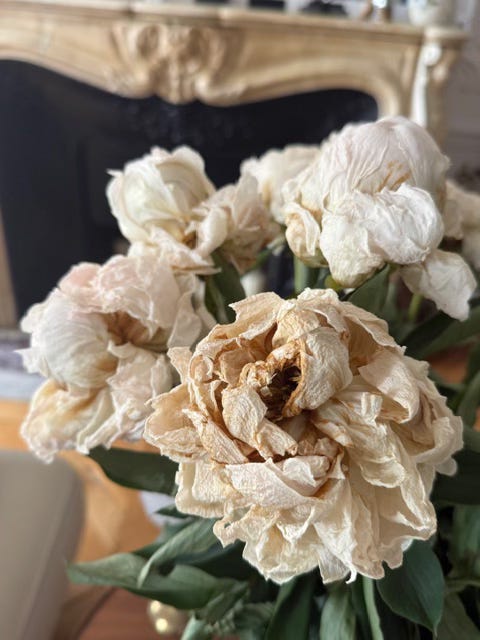
I keep the dead flowers. Always have. Not as some performative nod to impermanence, but because I forget to throw them out and then, when I finally remember, they are too beautiful in their surrender, just like Baudelaire wrote “Le beau est toujours bizarre.” (Beauty is always strange.) Something in the stoop of the stem, the way the bloom collapses inward like it bows to a god it no longer believes in. It feels honest. The unfiltered end of something that once begged for sunlight now asking only for privacy. There’s no need to be inspiring anymore. That, ironically, is the most inspiring part.
It’s strange, isn’t it, how decay has become unphotogenic. Now authenticity is filtered, vulnerability is monetised, and sadness needs to be hot to be palatable. You are allowed to fall apart, but only if you do it like a French film character, beautiful in shadow, with a cigarette dangling and cheekbones sharp enough to puncture narrative arcs. The rest of us, those who fall apart messily, ungracefully, without a decent soundtrack, are quarantined to the margins.
There’s a whole economy now built on “rawness”, but God forbid you rot out loud.
And don’t mistake this for romanticising decay. It’s not romantic. It’s messy. It smells. It leaves rings in the vase and pollen-stained tablecloths. But what it does, what it offers, is liberation from performance. A dying flower doesn’t care if it’s liked. Neither does an aging woman who’s finally bored of being legible. The dignity isn’t in the bloom. The dignity is in the disinterest. In no longer needing to be interpreted.
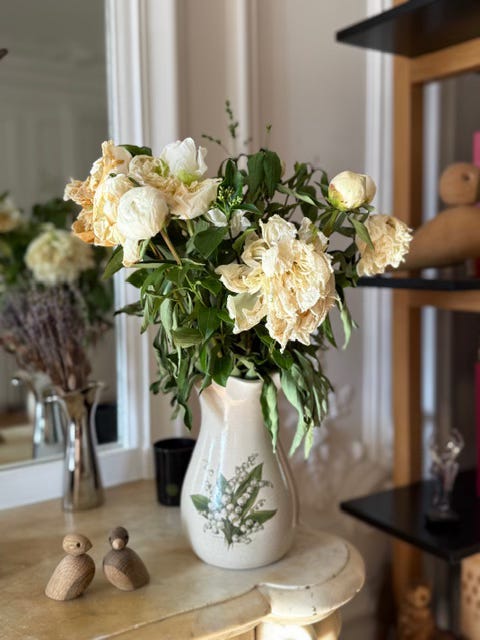
My grandmother used to keep a vase of dying roses by the window. I asked her once why she didn’t replace them. She shrugged. “They’re company”, she said, “and they don’t ask anything of me anymore”. That line has haunted me in the way only a casually dropped truth can.
We spend so much time trying to be useful, desirable, strong, relevant, extraordinary. But there’s a strange and rare peace in simply being, used up, unremarkable, still warm with memory.
Five hundred years ago, decay was a metaphor. Now it’s an inconvenience. Renaissance paintings were obsessed with vanitas – rotting fruit, skulls beside mirrors, hourglasses tick-tocking next to silk and jewels. It was a way to remind the rich that they would die too. (Spoiler: they didn’t listen.) Later, we industrialised death. Made it hygienic. Fluorescent. Whispered behind curtains. Even grief became suspect, something you are allowed for a week, maybe two, before you are expected to return to your inbox and resume consuming. Meanwhile, aging is now treated like a mistake that can be corrected with subscription serums and disciplined optimism. Even time has become a branding problem.
It wasn’t always this way. There were brief, inconvenient eras when decay was treated as sacred, but even then, only under supervision. The Romantics flirted with it intensely, poetically, and with a reliable exit, the way the privileged flirt with danger. They adored ruins as long as the ruin had narrative value, as long as collapse could be translated into longing, masculinity, genius, or a woman dying beautifully for someone else’s development arc. Decay was acceptable if it remained symbolic, legible, erotically available. They didn’t want rot; they wanted permission to feel profound without losing control. The grotesque could appear, but only if it knew how to pose. Only if it had good hair, good lighting, and the decency to die on cue.
Fast-forward to now, where rot is either digitised into horror content or cropped out entirely. The Instagram algorithm doesn’t reward entropy. You’re not going viral for posting your actual breakdown unless you are cute-crying and it comes with a discount code. But there are still unmarketable cultures where the crack isn’t redeemed or reframed, just lived with, where damage doesn’t need to be instructive or beautiful to be allowed. In the West, we patch. We conceal. We Botox the reminder. If a woman’s face shows wear, she must either explain it (job, motherhood, divorce, not enough collagen) or be erased by the feed’s indifference. There’s no room for things that don’t ask to be consumed.
Decay is democratic. It does not care about status, algorithmic ranking, or your skincare routine. The queen and the waitress will both sag. The influencer’s pout and the old man’s tremble will, in time, arrive at the same slackness. Nihilism?! No! It’s relief. Watching the flesh give up its need to seduce feels deeply egalitarian.
Beauty, finally, is just biology relaxing.
I’ve also learned it’s generous. In the garden, rot feeds next year’s bloom. In the psyche, a cracked certainty makes room for nuance. In the heart, especially the heart, decay clears space for unexpected tenderness. The one that whispers, “I’m still here”, after the love has technically expired. The one that doesn’t need to be named to be real.
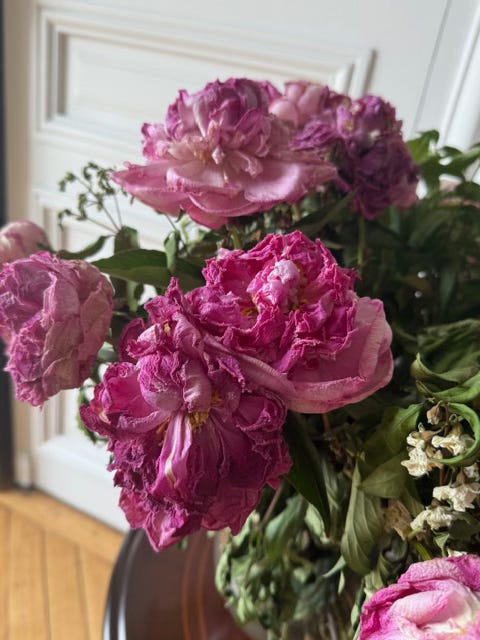
We are not taught to find beauty in aftermath. We are taught to fear irrelevance, to manage decline like a failing brand, to weaponise positivity against our own pain, to reframe exhaustion as gratitude, to translate grief into “growth” before it has even finished speaking. But some of the most truthful moments I’ve witnessed in life came from people who had nothing left to sell. There’s a nobility in collapse, when it isn’t curated, when it just… is.
Ten years ago, my shift wasn’t philosophical, it was behavioural. I stopped correcting how I came across. I stopped smoothing my sentences, my face, my reactions, even when no one was watching. I noticed how often I stayed “on” in private, how performance had silently followed me into solitude like a second skin. That’s when irrelevance stopped frightening me. What frightened me was the possibility of continuing to rehearse for an audience that wasn’t there, of mistaking coherence for truth, polish for presence. Aging, and disease back then, didn’t take anything from me. they revealed how much energy I had been spending on being interpretable.
I don’t want closure. I want honesty. I want the unmarketable moments. The sag. The souring. The awkward silence that doesn’t get edited out in post. I want to write things that sit in your throat like a bone. Something to reckon with, not repost. If decay teaches us anything, it’s that real beauty has nothing to prove and nothing to hide. It just stays. Until it doesn’t.
And maybe that’s the only kind that ever mattered, the one that was never trying to last, only to be real. The one that asks nothing of memory, nothing of investment, nothing of applause, or of the future. The one you recognise even if it doesn’t shine because, when it’s gone, something in you finally rests.
Still here, present without performance, with nothing left to prove,
Tamara


This is a stunningly careful way to enter a fragile room without knocking anything over, the framing is tender without being precious, incisive without turning cruel. Tamara, you manage to talk about decay without turning it into either a fetish or a sermon, which is rare in a culture that can only integrate softness if it’s inspirational or profitable.
Your essay also exposes that our fear of decay isn’t really about aging or death. Witnesses is the key word here. Modern society doesn’t mind deterioration so long as it happens off-camera. What we cannot tolerate is unmanaged visibility: decline that refuses to be narrativized, monetized, or framed as “content”. We haven’t lost reverence for withering. We’ve lost patience for anything that won’t cooperate with the audience’s appetite.
There’s an unspoken social contract now, you may suffer but only if your suffering remains legible and productive. Grief must teach. Exhaustion must optimize. Aging must explain itself. Decay that doesn’t resolve into meaning is treated like a technical error. No wonder irrelevance feels like a threat.
We’ve confused being unseen with being erased.
And here’s the dark joke of it all: we call this progress!!!
We replaced vanitas with wellness, skulls with serums, mortality with maintenance. The memento mori used to humble the powerful, now it just sells them another product.
Death didn’t disappear, it got outsourced to logistics and euphemisms, while rot itself became impolite.
Your grandmother’s roses feel like the real heresy here. “They don’t ask anything of me anymore” is practically an anti-capitalist manifesto in a vase. In a world that extracts value from every expression, every feeling, every wrinkle, the idea of companionship without demand feels extraordinary. A dying flower, like an aging woman uninterested in legibility, refuses the economy entirely.
The wit of your essay is that it doesn’t beg us to admire decay. You remove the camera and let it exist. And that absence of performance is exactly what makes it unsettling. Because once beauty stops auditioning, we’re forced to ask why we needed the audition in the first place.
This is not about flowers. It’s a critique of a society that panics when nothing is being sold, recalibrated, explained, or improved.
How much depth and complexity in an essay that looks so simple. Brava!
It's tempting to mention algorithms and social media with its gild-covered rot, but I suspect that the root of this is far older. If you're in the industrialized west, you're the product of generations of people who have mostly gone their whole lives without confronting decay and death directly. We have sewage systems to dispose of waste, armies of men in trucks to dispose of refuse; people rarely die in the streets, and most will go their entire lives rarely coming into contact with a dead body or even a dead animal.
As an extension of this, we don't perform proper autopsies of success or failure. Most failures are obscured and quickly discarded like rotting carcasses; success is lionized and immortalized, as if success itself is a separate entity from failure. The obscured truth is that failure is a necessary condition for success, and is constituted as such; additionally, success has its sunset; it's not a permanent state.
We no longer honor the elderly; we don't thank the dead flowers for fulfilling their purpose and dying honorably; instead we pathologize age and hide decay, to convince ourselves that progress is linear and growth is infinite. It's pretty difficult to get people to worship money, beauty, youth and success by assessing those things honestly as being temporary in nature. Instead, it's a binary; you either ARE or you AREN'T. Wrinkled faces and dead flowers are an inconvenient reminder that you can't buy time, that beauty and health aren't forever, that success isn't always earned, that hard work isn't always rewarded, and that an audience, no matter how big, can't save you from irrelevance.
How fitting that this piece cuts and illuminates without lingering. Brief, beautiful, and retiring with dignity. It's one thing to write well, but it's another to use the structure of the work itself to embody the thesis. This is a kind of artistry that most won't recognize, but they'll feel. Well done, Tamara. This one haunts.