
Friends or Assets?
The last unprofitable relationship

We have reached the point where people say they are “investing” in a friendship and do not hear themselves do it. Over a coffee booked three weeks ahead, someone will tell you that a particular person is “worth the energy”, that some other relationship has stopped being “a good use of their time”, that they are “protecting their peace”, that they are trying this year to be “more intentional” about who they let into their life, which always turns out to mean fewer people and better-credentialed ones. I used to find this depressing. I find it familiar now, which is worse, because familiar means the vocabulary climbed into me too while I had my back turned.
We did not stop having friends. We acquired a network instead, and a network is friendship’s understudy; word-perfect and feeling none of it.
A relationship wants to know who you are. A network wants to know what you can do, who you happen to know, whether you might prove useful eighteen months from now when the wind changes. That second curiosity does no obvious harm. It is simply tireless, and it has steadily devoured the first. This is the dialect of middle management applied to the heart: connections, leverage, social capital, value exchange, synergy (God help us all!!!), networking opportunity, audience, reach, collaboration potential, emotional labour, bandwidth, boundaries that apparently need “maintaining” like a suburban hedge. A worrying amount of modern friendship reads like a LinkedIn profile that has lately discovered the word “vulnerability” and is deploying it for engagement.
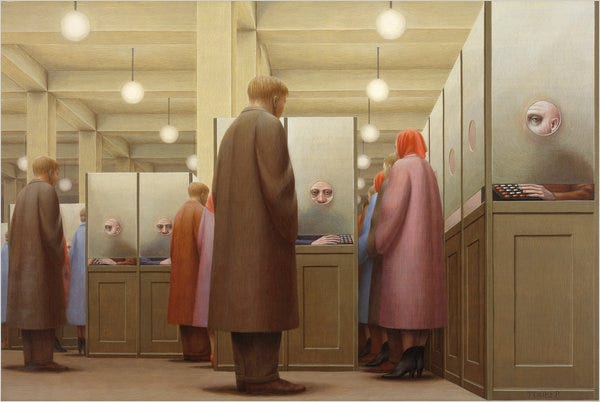
People did not get worse, whatever the weekend columnists imply. People are about as disappointing as they have always been, which is to say lovable and tiring in roughly equal and entirely unpredictable proportion. What shifted is that we grew frightened of imbalance. We want the message answered, the favour returned, the dinner reciprocated inside a socially respectable window, the emotional effort clocked and, ideally, matched. Keeping the books feels safe. It feels grown-up. It feels like insurance against being the idiot who loved more.
And friendship, the real and inconvenient friendship, is the one bond that flatly refuses to keep an honest ledger. You will always have given more to one person and less to another and you will mostly never find out which, and the never-finding-out is not a flaw in the arrangement. It is the arrangement!
There is something sadder folded underneath the fear, though. A great many people have forgotten how to move towards another human being without a reason in hand. Need hands you a script. “I’m calling because.” “Wanted to pick your brain on.” “Sorry to bother you, quick one.” We have all had the text from the friend who materialises only when they are moving flat, job-hunting, freshly dumped, or simply bored and trawling for company, and we resent it, reasonably. But the resentment covers something bleaker, which is that for a lot of us now the friend-who-only-rings-when-they-want-something has stopped being the exception. For many of us that friend is the only register left. The visit with no purpose, the call about nothing in particular have become genuinely frightening. What would you even say? What is it for?
Aristotle, who thought about this more clearly than our entire wellness economy combined, set friendship near the very top of a life worth living, well above most of what we would now file under success. He meant the demanding kind, the friend you choose for the sake of who they are rather than for what they slip you under the table. He understood the lesser kinds perfectly well, the friendships of usefulness and the friendships of pleasure, the people we keep close because they are handy or because they are fun, and he was not sniffy about them. He simply noticed that they evaporate the instant the usefulness dries up or the fun gets boring. The higher sort does not evaporate, having never been bolted to a function to begin with.
Friendship, after all, produces nothing. Nothing ships. Nothing scales. You sit. You grumble about the same colleague you were grumbling about in 2014. You squander an entire grey afternoon and at the end of it there is no deliverable, no asset, no metric to send upwards, nothing to report at the stand-up, and yet that squandered afternoon turns out to be holding the weight in a way none of your achievements ever quite manage.
(Cioran, my fellow insomniac, claimed to despise almost everyone and then spent decades writing them letters. The misanthrope’s secret is that he keeps the appointments. I find this enormously comforting, which probably says something about me I would rather not examine right now.)
C.S. Lewis, no sentimentalist, made the point that friendship is the one love with no survival value at all. The species does not require it. You can eat, breed, rear your children, hold the perimeter, and go to your grave without ever once having had a real friend. And that, he thought, was precisely its dignity.
Friendship is not among the things that keep us alive. It sits among the things that make being alive worth the bother. We have built a civilisation that comes out in hives at the sight of any bond it cannot enter on a balance sheet, and friendship has always been the bond that enters as zero.
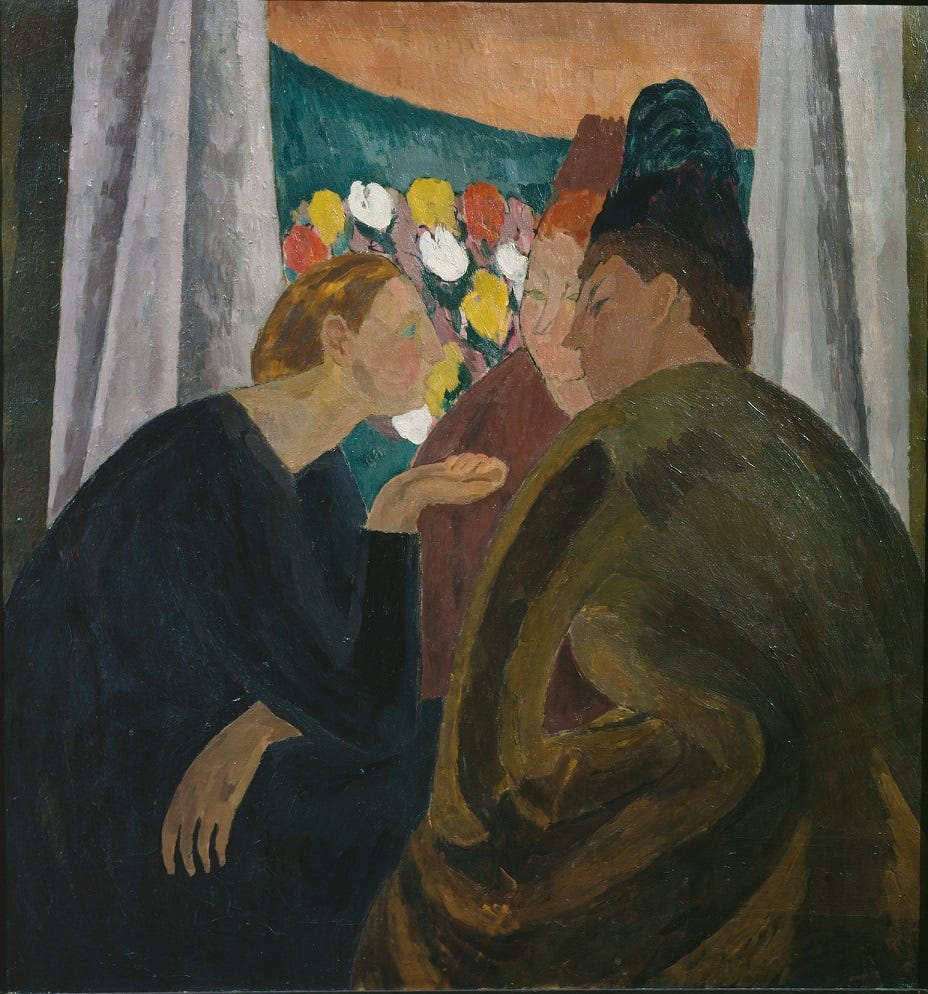
A friend of mine moved to a big city a few years ago and announced, with the bright resolve of a man taking up a fitness regime, that he was going to build a community. His phrase. He wanted friends, plenty of them, the right sort, and he wanted in to the circles, and he went after the whole thing the way you go after a promotion. Dinner parties where everyone had read the same three books, a Sunday thing in someone’s loft or suburbs garden, a board-game night he openly loathed. He treated friendship as a pipeline problem. None of it took, because the thing he was hunting only ever turns up once you have given up the hunt, once you have simply landed in the same place beside the same person often enough that something settles between you that neither of you agreed to. Friendship grows the way moss grows. You do not install it. And it gets harder every year to let anything grow that slowly, because we have mislaid the same-places, the office half-emptied and the calendar now filling so far ahead that being spontaneous needs a booking. So, the old accidental method, the one that used to make friends of us almost against our will, gets fewer and fewer chances to do its work. I still cannot explain to him what went wrong. He did everything right. That was exactly what went wrong.
You cannot recruit your way into being loved, and the harder you interview for it the more plainly the room can smell the vacancy.
Now I picture friendship as the one address you can turn up to carrying nothing. No good news, no glow-up, no anecdote rehearsed in the lift on the way up, no improved and edited version of yourself. A friend is among the very few people in front of whom you are permitted to arrive undecorated and frankly a bit of a wreck and be let in anyway. Try that on a feed and watch the numbers punish you for it.
Which drags me towards the cruelty in the middle of all this, hard to write about without tipping into pamphlet. We have never had more access to people and never had less access to friendship. I can tell you what someone I last saw in 2019 ate for lunch on Sunday. I know their politics, their holiday, the angle from which they prefer to be photographed, the new dog. Whether any of them is actually all right, I have not the faintest idea. That is not closeness. It is observation with a little heart-shaped button bolted on, and we have collectively agreed to file the whole thing under keeping in touch.
Familiarity wears friendship’s clothes and fools us because being recognised is its own small narcotic. One sort of person knows your face, your output, your highlights, your curated choices. The other has some rough idea what goes on inside you after the lights go off and the audience files out. We keep taking the first for the second, then lie awake wondering how we ended up so surrounded and so unmet.
The bleakest turn is this.
We have slid into being consumers of one another, and a consumer holds one sacred right, the right to be dissatisfied and to take his custom elsewhere with no hard feelings.
The consumer asks whether the product still meets his needs this quarter. The friend asks what on earth is happening to you, why you have gone so strange and so silent lately, what broke, and then stays put long enough to find out. Those two questions do not want the same thing. One is guarding my comfort. The other is guarding the actual person in the room, who is, maddeningly, permitted to change, to falter, to vanish for a while, to go through a long ungainly stretch of being really hard to love, and who under the old laws of friendship gets to do every bit of that and keep me regardless.
I should own up to where I learned any of this, because theory about friendship is a touch like sheet music about kissing.
The friendships that actually held in my life were not built out of the grand evenings at all. They got built out of repetition so unremarkable I would blush to itemise it. There is a friend with whom I have had, by my estimate, the identical argument about her impossible mother something like four hundred times. There is another who has heard my opinion of one particular novel so often that she now performs it back at me, badly, before I can get going, purely to watch me “suffer”. My grandmother kept up a correspondence with a schoolfriend across sixty years that held, as far as anyone could ever establish, almost no information at all, only the steady proof that the other one was still there, still writing, still alive to be written to, still livid about her knees.
Nothing happened in any of it. The tea went cold. We told the same stories until they stopped being stories and turned into something nearer to liturgy, the sort you stop listening to and start belonging to. And those cold-tea afternoons are, I now understand, most of what I own that I would refuse to sell.
I had a clean ending drafted for this. A graceful little pivot about meaning where the market keeps demanding value, the closing line you could screenshot and pin to a wall. I am not going to hand it over, first because I no longer trust it and then because I have stopped believing friendship resolves itself into a sentence at all.
Here is the smaller thing instead. Last winter a friend I had been slowly mislaying, to distance, to time zones, to the usual wordless drift, to the simple fact that neither of us ever “circled back”, rang me for no reason on a Sunday night. No favour attached. No news to deliver. She had read something and wanted to read it to me. We stayed on the line the better part of an hour and produced precisely nothing of value, and afterwards I sat in the dark with the owl figurines watching me from the shelf, and I thought, that. Whatever that just was. That is the one thing the whole machinery around me cannot put a price on, cannot sell back to me, and works very hard, every single day, to convince me I never needed.
I think I will ring her tonight. Not about anything.
Yours, owing you nothing that either of us could ever put a figure to, and meaning to go on owing exactly that for as long as you will have me,
Tamara
Not a tip jar. A ledger for what you underlined in your mind.
MUSEGUIDED exists because of its readers. If you want to be part of it, subscribe or upgrade, I’d be glad and grateful to have you.
As a concept, "opportunity cost" might be one of the most damaging ideas to ever be mixed in with social relations. All of the language you mention in your opening: "investing", "networking", "energy", "use of time", "connections, leverage, social capital, value exchange, synergy", all hinge on opportunity cost. In other words, they're all centered around your attention being a finite resource that, once used in one place, on one friend, in one relationship, is then permanently spent and, in turn, wasted when it pays no dividends.
The logic sort of holds because we're all working with limited time and energy, but the valuation is wrong. Market logic dictates that value only exists where a price can be set, and all things that cannot be priced are worthless, and this logic has seeped into every aspect of our lives.
Opportunity cost is a phantom hazard. The idea that we value the things we do in relation to all the things we can't do is deranged. It's the equivalent of scrolling Netflix endlessly, looking for something to watch, but dismissing everything you come across because you're not sure it's worth the 90 minutes, and you'll be too preoccupied with all of the other things you could be watching instead. So the net result is that you end up watching nothing, and somehow that's more prudent than taking a shot on a random experience and seeing it through to the end. The fear of loss is so great, but the fear itself is vampiric, wasting more time and opportunity than any failed "investment", or spent opportunity cost, by orders of magnitude.
Brilliant and incisive as always, and uncomfortable in the best ways. Your values are curated and calibrated to a degree of precision that I deeply admire.
And once again you identified something even deeper than the language of “investment” creeping into friendship. We’ve also imported the logic of optimization, that penetrates everything nowadays. Not only do we ask whether people are useful, we ask whether a friendship is the best possible use of our finite social resources. The tragedy is that this horrible optimization is the enemy of attachment. The most valuable people in my life would never have survived an efficiency review.
Years ago, I kept meeting an older man at the same café. We had almost nothing in common. Different generation, different politics, different profession. If I had evaluated that relationship the way modern life teaches us to evaluate everything, I would have concluded it offered no leverage, no opportunity, no measurable return. Yet over time he became one of the people whose perspective shaped my thinking the most. The friendship’s value was precisely that it could not have been predicted in advance. Networks reward relevance. Friendships reward surprise.
That insight runs beautifully through this essay. You remind us that friendship is one of the last places where uncertainty is a gift to receive. We do not know who will matter to us 20 years from now. We do not know which repetitive conversation, which pointless phone call, which cold cup of tea will become part of of a life.
And that may be the most impressive achievement of your essay, Tamara. In a culture obsessed with measurement, you make a compelling case for the immeasurable without becoming sentimental. That’s soooo rare today. Most writers either romanticize friendship or reduce it to sociology. You somehow managed to defend its mystery.