
Being Someone’s Exception
The gift, the debt, and what it asks of you

Nobody warned me that being chosen could feel like being owned.
Not the ordinary choosing, the mutual, polite negotiation of affection where two people more or less agree to tolerate each other’s presence and call it love. I mean the other type, where someone who has spent years perfecting the art of emotional unavailability suddenly, inexplicably, makes an opening in themselves specifically shaped like you. They answer your message at two in the morning when they answer nobody’s messages at that time. They tell you things they have not told their therapist. They cancel plans for you and cancel is not even the right word because they don’t make plans for anyone, so there is nothing to cancel, only a rare and slightly alarming willingness to show up that materialises, specifically…. for you. You are, as they will eventually say (and they always say it, as if it explains anything), their “exception”.
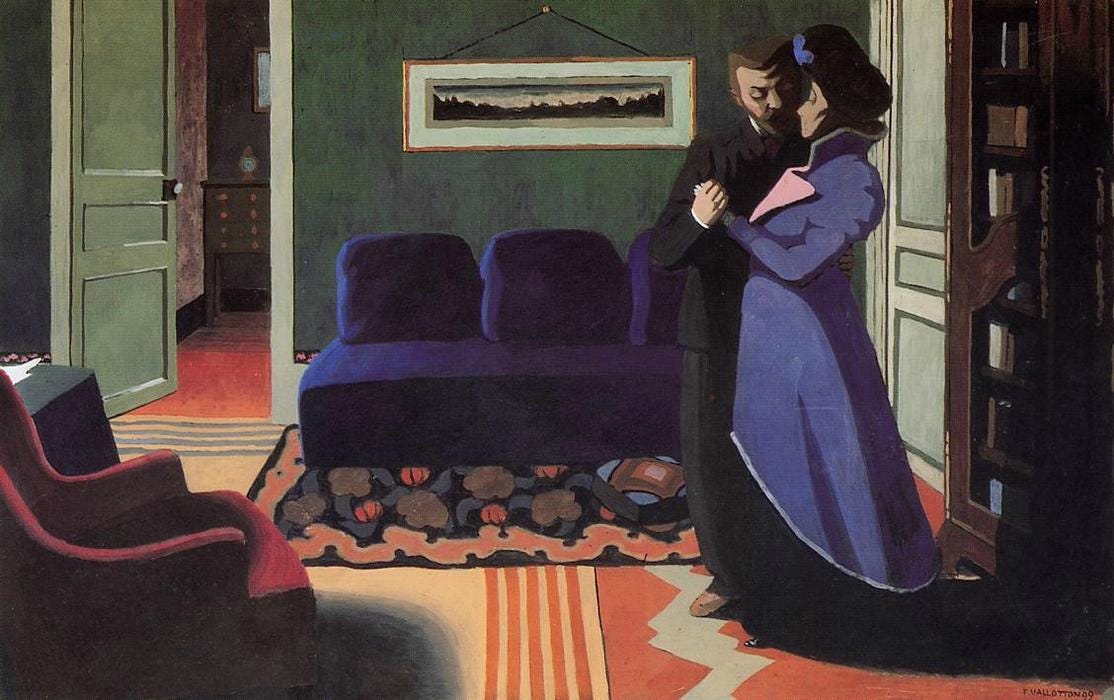
What they mean is: you are different. What they don’t say is: and I don’t entirely know what to do with that.
What puzzles me about this is that the language of the exception is always given as a compliment. You are singular. You have broken through. Whatever fortress they have built, and people who call you their exception always have fortresses, elaborate ones, with histories, you have somehow got past it. You should feel flattered. Most people don’t get past it. The implicit structure of the compliment is comparative: “I don’t do this for anyone else”, as if your value were not established by any inherent quality you possess but by the statistical rarity of their response to you. You are the anomaly in their data set. Congratulations!
But even as I write this I’m aware I’m being unfair, or at least incomplete. Because there is also something extraordinary in it. Something that does not resolve neatly into suspicion.
I have been someone’s exception. Not once. More than once, in different registers, different intensities. The friend who never confided in anyone but found themselves confiding in me; the person who does not love easily who suddenly loved easily, with me; someone whose patterns were so entrenched that watching them break one felt like watching a tree bend in a very still place. And in each case I knew, with the peculiar and slightly vertiginous clarity that comes from being chosen by someone who does not choose, that I was inside something that mattered. That I was being let in. That whatever closed-off machinery usually governed them had, for reasons neither of us could fully account for, shifted.
The question I kept not asking was: what does this require of me?
Montaigne’s line about La Boétie, “parce que c’était lui, parce que c’était moi” – because it was him, because it was me, gets quoted so often it has lost most of its strangeness. But what I keep coming back to is not the declaration itself, it’s what Montaigne did not do with it. He didn’t try to explain the friendship. He didn’t theorise it into a framework. He just sat with the fact of it, and then, when La Boétie died, he mourned. Which is the more useful response, actually, though it took me an embarrassingly long time to understand why. The theorising comes later. It always comes later, when things go strange, and you are lying somewhere at an hour that is not quite night anymore trying to work out why you feel so hollowed out by someone who kept telling you how singular you were to them.
And one thing that goes strange, you start to behave like someone who must justify the exception.
This is subtle at first. You don’t notice it as behaviour, more like a sort of low-grade vigilance, a monitoring of your own conduct in relation to this person that doesn’t operate in your other relationships. You are, without quite deciding to be, careful. Careful not to be too much. Careful not to be too little. Careful not to ask for the thing that would reveal you asking for it. Because, and this is the part that becomes uncomfortable to think through, they have made it clear, through the very construction of being your exception, that their capacity has a ceiling. You are above the general threshold. You are not above all thresholds. BUT, there is still a ceiling. You are just standing closer to it than most.
Which means you are always, at some level, aware of the ceiling.
Joan Didion described grief as the absence of the person who used to tell you who you were. She was talking about death, but I think she was also, maybe inadvertently, describing a specific quality of being closely known by someone, which is partly constitutive. Someone who witnesses you, especially someone who witnesses you in preference to witnessing others, becomes validation. And it is not a healthy validation, the one the wellness industry would like to sell you, the robust inner selfhood that requires no external validation, presented in a sophisticated graphic with an elegant font. The other validation, true for all humans as a matter of fact, regardless of how evolved they are.
Being seen by a specific person, particularly a person for whom seeing does not come easily, does something to how you experience yourself.
And so, when the exception starts to feel conditional, when you begin to suspect that your singularity is not entirely about you, but about what you have agreed, however silently, not to demand, then it doesn’t feel like a relational disappointment. It becomes a small ontological wobble. Something about the shape of you becomes uncertain.
It turns out the seduction is not that they chose you. It’s that YOU chose to stay chosen, and that requires, not emotionally, not in the abstract, but structurally, practically, in the slow decline of very specific things, a part nobody talks about. The part I haven’t told you yet.