
Alone, Finally
The contradictory pleasures of inhabiting yourself

“I want to be alone. I want to be left with this tremendous thing called life.” — Katherine Mansfield
Nobody warns you that the self is interesting. Not useful, not productive, not in need of refinement, just genuinely interesting, like a city you have lived in for years suddenly reveals a street you never noticed. This is what solitude does, eventually, if you can outlast the discomfort of arriving at it.
We have catastrophised solitude so thoroughly, retrofitting it as a symptom, a social failure, a proof of unlovability, that we have nearly lost the word for what it actually is: an interior country, fully habitable. The loneliness discourse, and there is a whole industry of it now, with wellness campaigns and government ministers for loneliness (the British government appointed one in 2018, which tells you something both touching and farcical about the state of things) tends to flatten the distinction between aloneness and abandonment. The result is that millions of people who are quite content in their own company have started to wonder, with increasing anxiety, whether they ought to be suffering more.
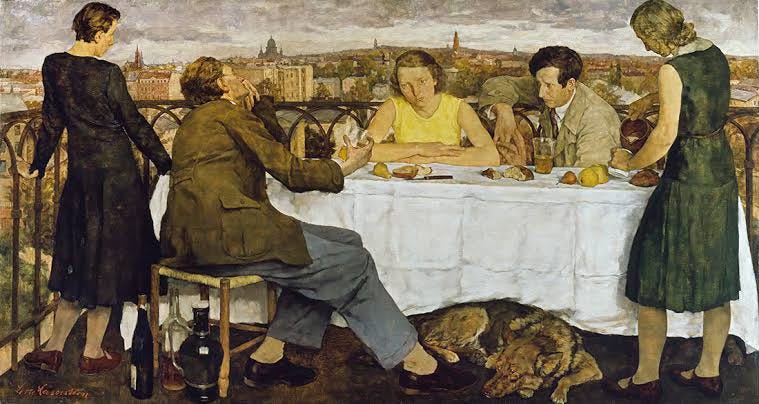
I was never lonelier than in certain relationships. Sitting across a dinner table from someone who had decided, some months earlier, to stop actually looking at me, I have known a solitude so loud it rang. That specific loneliness that arrives in company, that is, if anything, sharpened by proximity, is the crisis nobody addresses, because it disrupts the narrative. We prefer the image of a single person in a flat, eating toast over the sink, as the face of modern disconnection. Easier to legislate. Less embarrassing.
But solitude? Real solitude, chosen, entered deliberately as one might enter a forest is a completely different country. And like all countries worth visiting, it takes time to learn the language.
The philosophers knew this, though they expressed it with a severity that put most people off. Blaise Pascal’s observation that all of humanity’s problems stem from the inability to sit quietly in a room alone has been quoted so many times it has lost its edge, become decorative, a mug-print of an idea. Which is a pity, because Pascal was not talking about meditation retreats. He was diagnosing something genuinely disquieting, that we don’t flee the self because it is empty but because it is full – full of questions we have not answered, feelings we have not processed, a self-awareness that is, in the wrong circumstances, unbearable.
The noise we make (the scrolling, the scheduling, the relentless sociability) is not connection. It is avoidance with better branding.
Montaigne, who was wiser about this than almost anyone and who had the considerable advantage of a tower in which to do his thinking, wrote that we should reserve a back shop behind the boutique, a room entirely our own, where we establish our true liberty. This back shop is not a room you can buy or rent or access via a Headspace subscription. It is a cognitive space, a psychic interiority that modern life has been systematically reducing since roughly the invention of the smartphone. What Montaigne was describing, without using the word, because it hadn’t yet been weaponised by the self-help industry, was solitude as a form of sovereignty.
And sovereignty is exactly the word that the conversation around aloneness refuses to use. (I also refuse to use this word, in any context, because everyone has been abusing it recent years.)
Here is what nobody tells you about extended solitude. The first few hours are often the worst. There is an adjustment period, almost physical, where the body acclimatises to the absence of external stimuli, like a diver equalising pressure. You notice the things you had been using other people to avoid noticing. An old shame. An unresolved longing. A creative impulse you have been too embarrassed to pursue because pursuing it would mean admitting you cared. Then, if you wait, and this is the crucial instruction, this is the one that is the hardest to follow, something shifts. The interior becomes less threatening and more interesting. Thoughts begin to arrive as visitors, not accusations.
I have heard my thoughts purr in solitude, in ways they never could in company. And it is not mysticism but closer to acoustics. A crowded room is not a good listening environment.
There is a quality of attention that solitude enables which perhaps deserves its own name. Rilke spent years writing letters to a young man, Franz Kappus, aspiring poet, seeking guidance, and what he returned to, again and again, was not technique but receptivity: the capacity to wait on experience without forcing it into legible form. “I would like to beg you”, Rilke wrote, “to have patience toward all that is unsolved in your heart.” This is not advice you can action on a regular afternoon between meetings. It is the description of an interior posture that requires, as its precondition, a certain quality of quiet… not the absence of noise exactly, but the presence of enough stillness that something unformed can begin to take shape. Rilke himself was a somewhat unreliable human being, an indifferent father, a man who kept his solitude partly by leaving other people to carry the weight of ordinary life. The instruction is still correct. People can be right about things they fail to live.
What Rilke meant, and what gets lost when we reduce solitude to self-care, is the idea of befriending the self in earnest. Not the curated self, not the socially legible self that knows how to perform adequately at gatherings, but the stranger who lives behind all of that. This befriending is genuinely strange work. Most of us are better acquainted with our dentists than with this interior figure, and considerably less afraid of them.
The gendering of solitude is essential, not because it makes for comfortable thinking, but because it does not, and that is precisely why. Women who seek solitude, who protect it, who organise their lives around it, who refuse to fill it with sociability on demand, have historically been read as mad, cold, or failing at femininity. The word spinster used to be neutral, descriptive; somewhere it acquired its current freight of pathos and failure.
Meanwhile a man who withdraws into his study, his shed, his philosophical cave, accrues the automatic dignity of the thinker. Thoreau at Walden Pond is a cultural monument. A woman doing the equivalent tends to end up in a Charlotte Perkins Gilman story, being handed warm milk and told to rest.
Virginia Woolf’s “A Room of One’s Own” is so canonical now that we have forgotten how radical its basic argument was, or rather, we have absorbed the title and neglected to absorb the rage. Woolf was not writing a lifestyle guide to creative self-care. She was pointing at a material and psychological condition, the absence of space, literal and metaphorical, that had been systematically denied to women for centuries and whose denial had real, measurable consequences for the inner life. A room. Money. Time. These are not luxuries in Woolf’s argument; they are the preconditions for a particular kind of consciousness. We have turned her thesis into a Pinterest board.
The female solitary is still, in 2025, treated with ambient suspicion. Travelling alone, eating alone, choosing alone are acts that carry a residue of pity that no one applies to men doing the same things. I find this interesting mainly as a symptom, it tells you that solitude, when chosen by women, is legible as refusal. And refusal, culturally speaking, makes people uneasy.
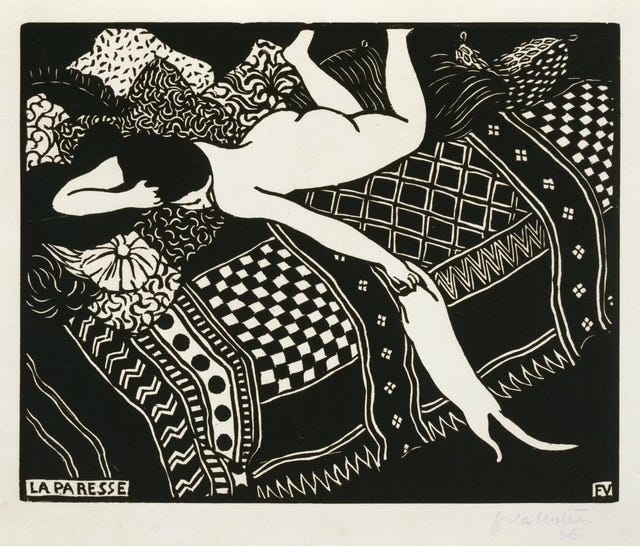
There is a relationship between solitude and desire that rarely gets examined because it complicates the preferred narrative of aloneness-as-lack. But solitude is, in my experience, genuinely sensuous. Not in a way that requires euphemism. In a way that is about the heightening of perceptual attention that occurs when you are not distributing yourself socially.
Food tastes different when you eat it alone and actually taste it. A piece of music, Schubert, or Feldman, or late Coltrane, or something strange and slow by Arvo Pärt, can do things to you when there is no one else’s response to track. Walking alone in a city, with no one to perform enjoyment for, you start to notice things: the green of the moss on a particular iron railing, the grammar of a stranger’s coat, the way light falls on an ordinary afternoon in a way that is briefly, inexplicably heartbreaking.
The self, it turns out, is quite good company if you give it the chance to speak at its own tempo. This is what flirtation with the self actually means. No, not narcissism, which is paradoxically deeply other-directed and requires an audience, but true curiosity about one’s own responses, preferences, and tendencies when no one else is calibrating them. It is startlingly easy to spend an entire life never doing this. Most people don’t. They move from one relational context to another, defining themselves by contrast, by negotiation, by the approval or disapproval of others, without ever sitting with the unwitnessed self long enough to find out what it actually thinks. About anything.
The philosopher Charles Taylor spent a great deal of ink on the concept of authenticity and its deformation into a cultural buzzword meaning roughly “expressing your personal brand”. What he was pointing at was something more demanding, the idea that there is a self that precedes its social performance, and that accessing it requires sustained, uncomfortable attention. Solitude is the condition where that work becomes possible. You cannot hear a whisper in a nightclub.
The mystical traditions understood this, even when they expressed it in language that contemporary secular culture tends to find embarrassing. The desert fathers, those improbable 4th century Christians who went to live in the Egyptian desert for reasons that make complete sense to me, were not fleeing the world because they hated it. They were fleeing distraction because they loved something, or Someone, enough to want to be fully present to it.
The idea that solitude might be the condition of a certain quality of encounter, not escape but preparation for encounter, runs through contemplative literature from Meister Eckhart to Thomas Merton to, I would argue, certain secular writers who don’t quite realise they are making a theological argument.
Proust is one of them. The entirety of “À la recherche du temps perdu” is, among other things, a monument to the quality of attention that solitude makes possible. Marcel, confined, ill, cork-lined room, listening to the texture of his own memory is not a failure of sociability. This is a man doing something that required the withdrawal of almost everything else. The novel that resulted is evidence that the withdrawal was productive. Though I will say that seven volumes is perhaps a longer project than most of us need to undertake to prove the point.
I want to resist the gravitational pull toward a tidy conclusion about the redemptive power of solitude because that would be dishonest and also boring. Solitude is not always pleasant. There are evenings where the silence is not fertile but simply flat, where the back shop Montaigne described feels more like a waiting room, where the thoughts that arrive are not interesting visitors but old grievances in bad disguise. Solitude does not, on its own, guarantee insight. It guarantees exposure, and exposure to oneself is a mixed proposition at best.
What I have come to believe, with the appropriate lack of certainty, because I have been wrong about this before and will likely be again, is that the capacity for solitude is one of the less-discussed indices of psychological health. Not its proof, not a prerequisite, but an indicator of a self that can tolerate its own company without immediately dissolving into either entertainment or despair. Winnicott, the British psychoanalyst who was good at saying difficult things clearly, wrote about the ability to be alone in the presence of another, meaning an early developmental achievement whereby a child learns that their inner life is real and continuous even without constant external confirmation. Adults who never had this tend to be very uncomfortable with silence, in themselves and in others. They are not bad people. They are just, in a specific way, homeless.
I do not think solitude is for everyone in equal doses, and I am suspicious of the current vogue for framing it as a productivity hack, as though the point of going into the desert were to emerge with better output metrics. That is the loneliness industry colonising the one territory that was meant to resist it. But for those who can bear the adjustment period, who can wait out the first uncomfortable hours when the self is just getting warmed up, what becomes available is not transcendence, not enlightenment, not anything so photogenic… just a quieter, more accurate relationship with who you actually are. Which is, some days, more than enough to be going on with.
There is something I have never said in quite this way. The most creative periods of my life have not coincided with the richest social ones, but with the quietest. Isolation is not generative in itself, misery is not a muse, and anyone who romanticises suffering as a precondition for art has probably not suffered enough to know better, but in the silence something stopped performing and started thinking. The difference is not subtle. Performing-thinking produces what you already know, dressed up.
Actual thinking surprises you. It arrives sideways, at odd hours, in the middle of a sentence you were writing about something else entirely. And I suspect this is what we are collectively running from. We have become so afraid of being seen alone that we have started bringing our phones as chaperones. The phone at the restaurant table, the podcast on the walk, the television left on for company are not neutral habits. They are the contemporary equivalent of what Pascal diagnosed, which is to say they are the sound of a civilisation that has decided, at scale, that the self unmediated is an emergency. And perhaps it is.
Perhaps what we are really afraid of is not loneliness but lucidity, the specific, unflattering clarity that arrives when there is nothing left to look at but yourself. That clarity, uncomfortable as it is, does something to time that is difficult to explain without sounding slightly unhinged. In company, time is social, it moves at the pace of conversation, obligation, shared agenda. Alone, it does something stranger. It pools. An hour can contain what a week of ordinary living cannot because more is noticed. Certain afternoons in solitude have left deposits in me that years of busy sociability have not. I do not know what to call this economy exactly, except to say that it runs on a different currency, and that the exchange rate, once you find it, is remarkably favourable.
The door clicks shut. The city hums. And somewhere in the silence, just at the edge of audibility, a thought arrives that is entirely your own, unperformed, unsanctioned, not yet made legible for anyone else. For a moment, you are neither lonely nor accompanied. You are simply, and rather surprisingly, there.
Yours, from the interior country, where the door is always open, but the key stays with me, written alone, finally, and without apology,
Tamara
Not a tip jar. A ledger for what you underlined in your mind.
Museguided exists because of its amazing readers. If you want to be part of it, subscribe or upgrade, I would be glad and grateful to have you.
What is remarkable about your essay is not simply its defense of solitude, but the precision with which it separates solitude from deprivation. Most writing on the subject collapses into diagnosis or self-help. You masterfully resisted both. You treated aloneness as a perceptual condition, almost an artistic medium, and that distinction gives the essay unusual intellectual integrity. The passages on attention, especially the idea that solitude alters the texture of perception, are exceptionally strong. An artist immediately recognises this as true. The eye does not really begin to see until performance stops.
I love your argument that modern noise is not connection but avoidance with better branding. That line cuts because it reframes distraction as an aesthetic problem. We have lost tolerance for unedited consciousness. Contemporary life trains people to curate themselves continuously, which means many never encounter the raw material from which serious art, thought, or even genuine preference emerges. Your essay understands that solitude is not valuable because it is peaceful, but because it removes the audience. That is a much more difficult and interesting claim.
There is also something formally impressive in the way you move between philosophy, psychoanalysis, literature, and lived experience without becoming ornamental. Too many essays use references as social proof. Here, Pascal, Woolf, Winnicott, Rilke, and Proust function like structural beams; each thinker advances the argument rather than decorating it. That level of intellectual choreography is rare, but we are used to it in the Museguided salon — the only real salon on Substack.
I am also thinking about the relationship between solitude and aesthetic risk. From the perspective of an artist, solitude is not only where perception deepens; it is where taste detaches from consensus. In groups, people unconsciously stabilise one another’s preferences. Alone, however, you begin discovering what genuinely arrests your attention without social calibration guiding the response. This is why prolonged solitude often changes an artist’s work before it changes their personality. Certain colors become intolerable. Certain rhythms suddenly feel dishonest. Certain subjects begin insisting on themselves. Solitude recalibrates the sensorium before it recalibrates identity.
And perhaps this is another reason solitude unsettles culture so deeply. A person who has spent enough time alone becomes harder to market to, flatter, shame, or synchronize. They develop private standards of beauty and meaning. Economically and socially, that kind of inward independence is inefficient. Artistically, it is indispensable.
Tamara, the supernova shines again.
I appreciate the nuance here: solitude, not isolation; the gendered differences; being alone versus being seen alone; the fact that solitude does not mean introspection or productivity; and the fact that you recognize that it's less about the cliche of personal growth and more about the tolerance of discomfort, and familiarity with the self.
As with so many other things, the answer is in balance. Solitude is healthy in contrast with the social, and vice versa. Spending too much time doing one or the other has a cost, and because solitude represents a type of refusal, it is maligned and misrepresented as a threat, in the way that boundaries tend to be.
Boredom is an offshoot of this. The fear of isolation and the discomfort with boredom all reflect the dampening of sensory input. The dependence on phone is as much an addiction to sensory input as it is a desperate attempt to prove one's social viability. If productivity is the value, boredom represents a failure state, just as solitude is seen as a failure to socially flourish. What we can't perceive with our senses or validate through the eyes of another represents the most terrifying thing of all: ambiguity.
Well done, Tamara.